Where Nature Meets Concrete: A Symphony of Balance
-
Dates2023 - 2023
-
Author
- Topics Editorial, Nature & Environment, Fine Art
- Location Santa Cruz de Tenerife, Spain
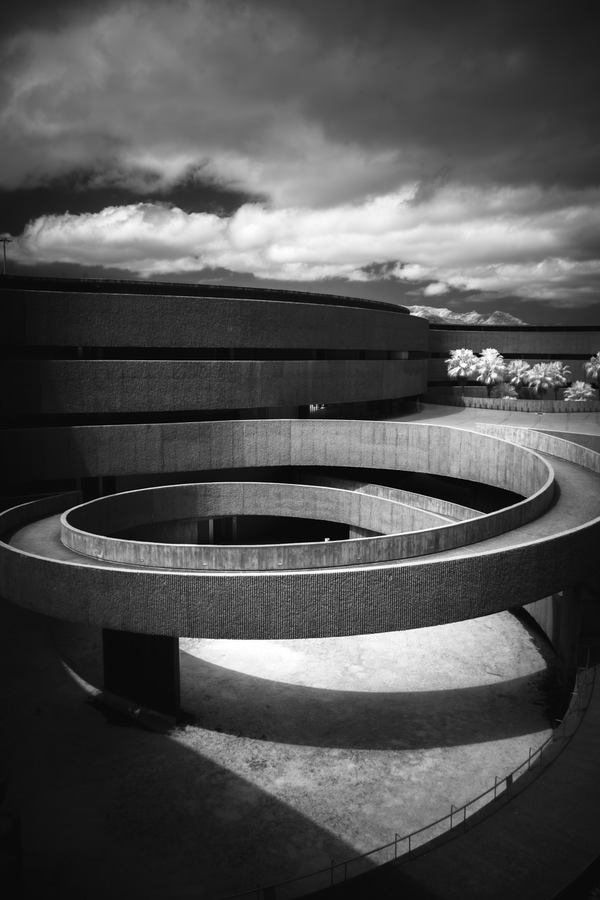
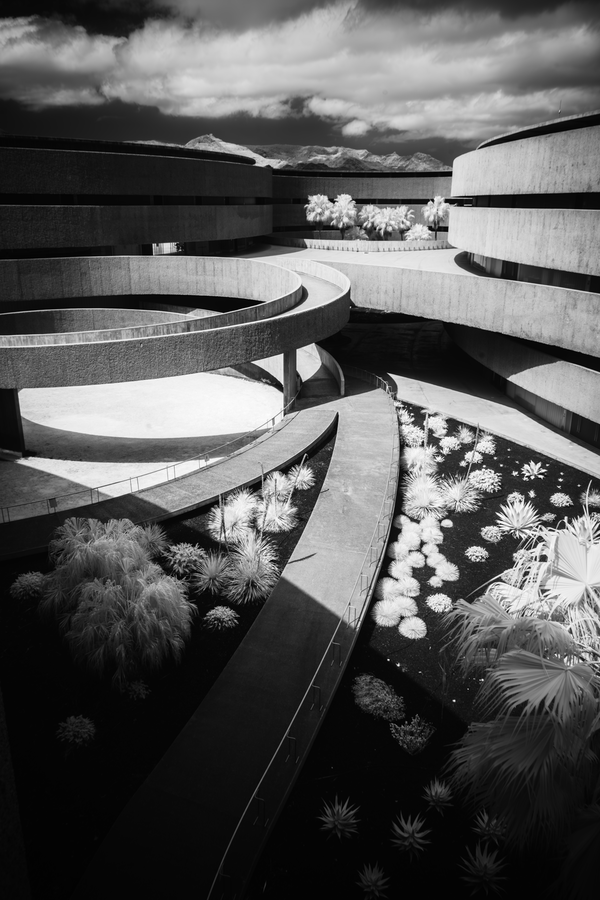
A visual study of the Faculty of Fine Arts in Tenerife. Captured in black and white infrared light, this series explores the dialogue between architectural rigidity and organic fluidity, where concrete and nature cease to compete and begin to coexist.
There is a building in Santa Cruz de Tenerife that does not impose itself on the landscape. It negotiates with it.
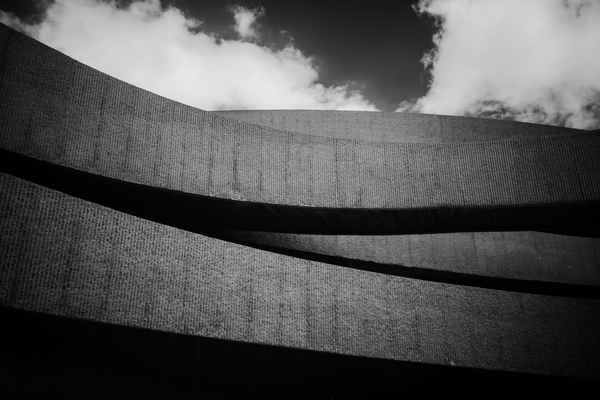
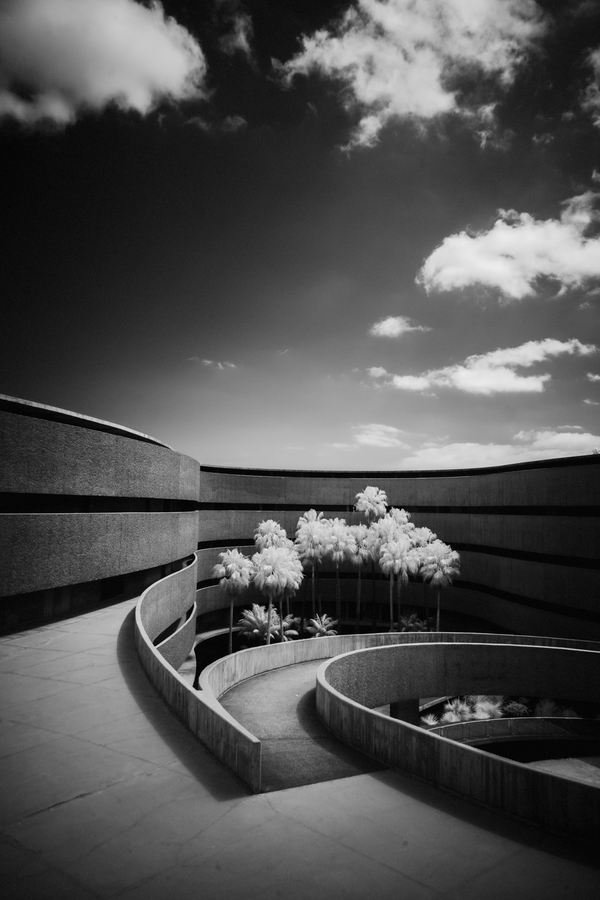
The Faculty of Fine Arts at the Universidad de La Laguna, designed by gpy arquitectos, is one of those rare architectural works where the gesture of construction feels less like an act of occupation and more like an act of listening. Circular volumes. Layered terraces. Concrete that curves rather than cuts. It is a structure that holds nature within itself, rather than pushing it to the margins.
I chose to photograph it in black and white infrared light.
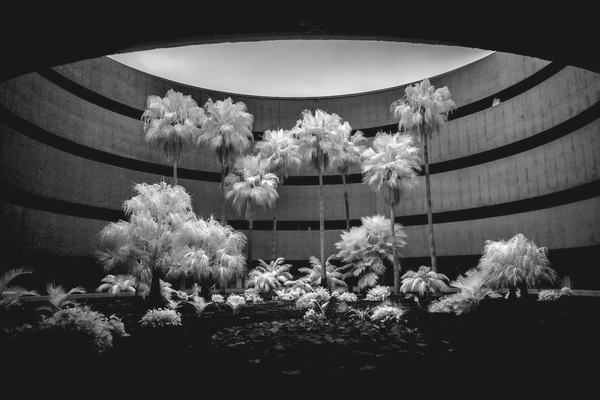
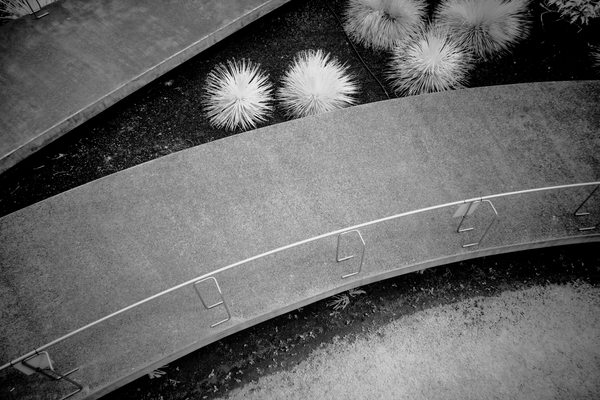
This choice was not aesthetic; it was conceptual. Infrared photography doesn’t merely decorate a subject; it discloses a frequency within it. Vegetation is rendered in luminous white; concrete is absorbed into deep grey; the sky is compressed into black. This palette strips away the incidental, forcing the eye toward what remains: form, texture, weight, and the precise geometry of relationships.
What I found inside that building was not a conflict between the built and the natural. It was a negotiation in progress. The palm trees growing at the centre of the spiral ramps do not fight the architecture. They complete it. The concrete does not suppress the vegetation. It frames it, protects it, and gives it a context in which to exist. The building seems to have been designed not around a programme but around a garden.
Shooting with vintage lenses added a layer of temporal ambiguity. The images do not feel entirely contemporary. They carry a grain, a softness at the edges, a quality that places them somewhere between document and memory. This felt right for a building that itself operates outside of easy categorisation, brutalist in material, organic in intention, modernist in language, almost classical in its relationship to the central void.
The absence of colour is not a limitation here. It is the condition that makes the dialogue visible. Without colour, the eye cannot rely on the obvious contrasts. It must read the image through tonal relationships, through the weight of surfaces, through the direction of light. This is how the series arrives at its title: not as a declaration, but as a question held open.
Where exactly does nature end and concrete begin? In these images, the boundary is never clear.