Taekwondo North Korea Style
Although the origins of martial arts are shrouded in mystery, since time immemorial men have used their hands and feet for self-protection. Influenced by a combination of historical events in Korea and Japanese traditions, the modern incarnation of Korea’s national martial art Taekwondo ("way of kick and fist") was created in 1955 by General Choi Hong-hi. Born in what is now North Korea, his idea was to develop a specific martial art to demonstrate the spirit and wisdom of the Korean nation to the outside world. Taekwondo is extremely popular in North Korea. It is taught in every school and is part of the daily sports and health routine of all DPRK citizens. After 50 years of existence, the art of kicks has 60 million practitioners in more than 120 countries. Taekwondo became a medal sport at the Sydney 2000 Olympic Games.

© Alain Schroeder - Image from the Taekwondo North Korea Style photography project
i

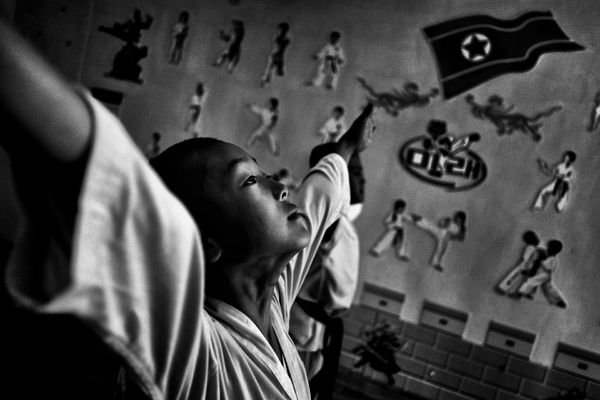
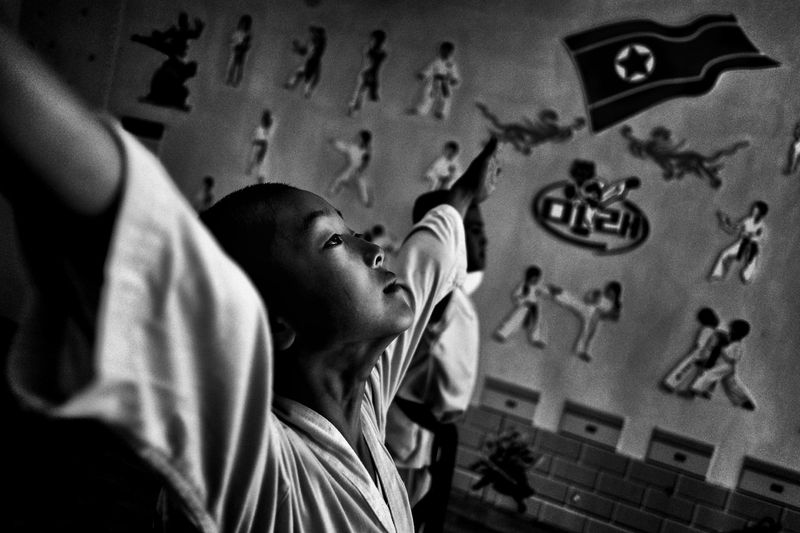
A moment of concentration for the children of Pyongyang’s Mirae Primary School in front of a wall with representations of the various movements of Taekwondo and the flag of North Korea. Although the origins of martial arts are shrouded in mystery, since time immemorial men have used their hands and feet for self-protection. Influenced by a combination of historical events in Korea and Japanese traditions, the modern incarnation of Korea’s national martial art Taekwondo ("way of kick and fist") was created in 1955 by General Choi Hong-hi. Born in what is now North Korea, his idea was to develop a specific martial art to demonstrate the spirit and wisdom of the Korean nation to the outside world. Taekwondo is extremely popular in North Korea. It is taught in every school and is part of the daily sports and health routine of all DPRK citizens. After 50 years of existence, the art of kicks has 60 million practitioners in more than 120 countries. Taekwondo became a medal sport at the Sydney 2000 Olympic Games.
© Alain Schroeder - Image from the Taekwondo North Korea Style photography project
i

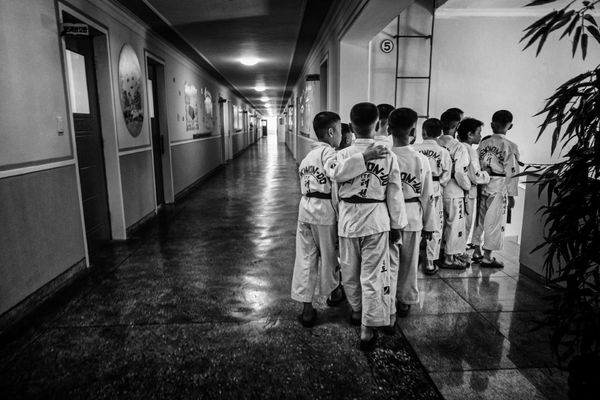
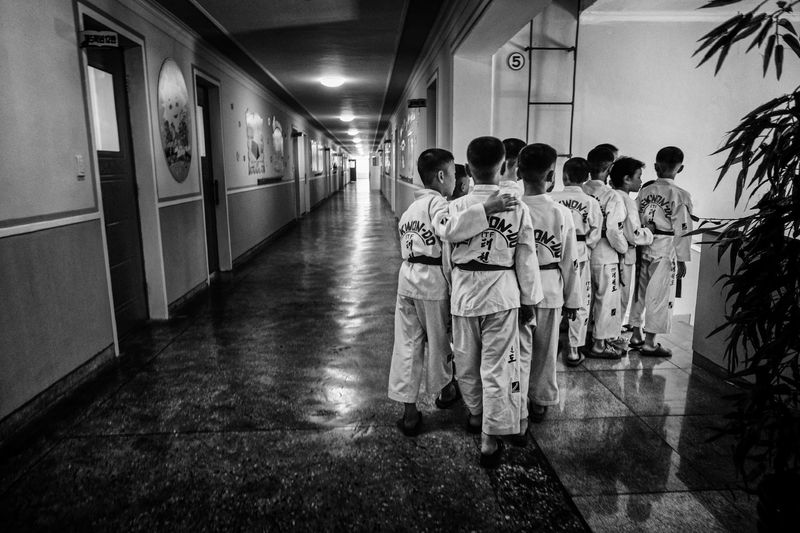
Discipline is severe and the tension is palpable during Taekwondo classes at Mirae Primary School in Pyongyang. Cohesion of the group, team spirit, respect for others and self control are drilled into the children, inciting them to surpass themselves. As they make their way down the corridor to the locker room, a boy wraps a consoling arm around his friend who has suffered a heavy blow. Although the origins of martial arts are shrouded in mystery, since time immemorial men have used their hands and feet for self-protection. Influenced by a combination of historical events in Korea and Japanese traditions, the modern incarnation of Korea’s national martial art Taekwondo ("way of kick and fist") was created in 1955 by General Choi Hong-hi. Born in what is now North Korea, his idea was to develop a specific martial art to demonstrate the spirit and wisdom of the Korean nation to the outside world. Taekwondo is extremely popular in North Korea. It is taught in every school and is part of the daily sports and health routine of all DPRK citizens. After 50 years of existence, the art of kicks has 60 million practitioners in more than 120 countries. Taekwondo became a medal sport at the Sydney 2000 Olympic Games.
© Alain Schroeder - Image from the Taekwondo North Korea Style photography project
i

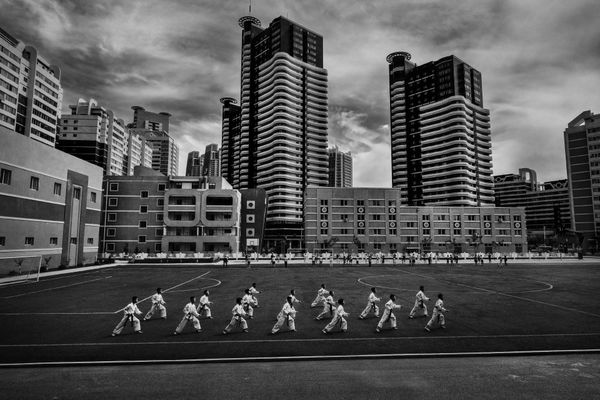
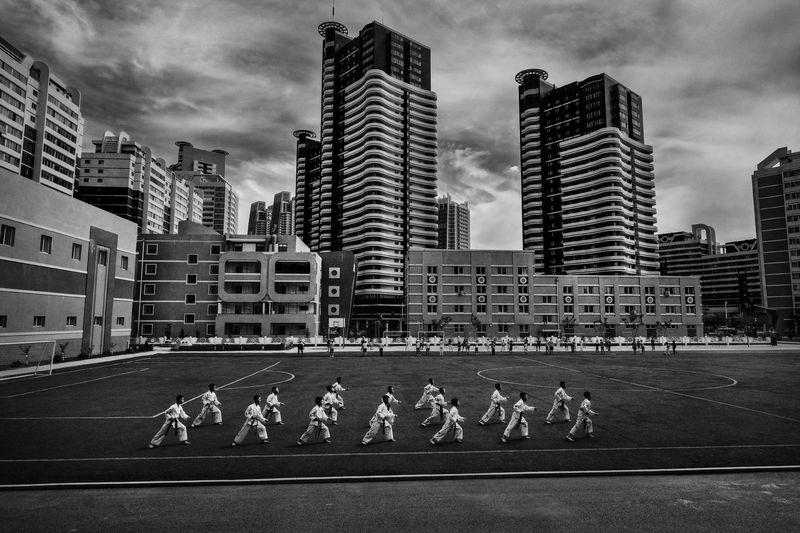
On the football field adjacent to Mirae Primary School, with the typical skyscrapers of Pyongyang in the background, children practice the synchronized execution of a tul, a series of offensive and defensive techniques against one or several virtual adversaries. The chon ji tul, which means heaven and Earth is the first tul (pattern) taught to beginners. General Choi Hong Hi, who was born in North Korea and served both the Japanese and Korean armies throughout his military career, developed his own movements which were officially recognized as the martial art of Taekwondo on April 11, 1955. Although the origins of martial arts are shrouded in mystery, since time immemorial men have used their hands and feet for self-protection. Influenced by a combination of historical events in Korea and Japanese traditions, the modern incarnation of Korea’s national martial art Taekwondo ("way of kick and fist") was created in 1955 by General Choi Hong-hi. Born in what is now North Korea, his idea was to develop a specific martial art to demonstrate the spirit and wisdom of the Korean nation to the outside world. Taekwondo is extremely popular in North Korea. It is taught in every school and is part of the daily sports and health routine of all DPRK citizens. After 50 years of existence, the art of kicks has 60 million practitioners in more than 120 countries. Taekwondo became a medal sport at the Sydney 2000 Olympic Games.
© Alain Schroeder - Image from the Taekwondo North Korea Style photography project
i

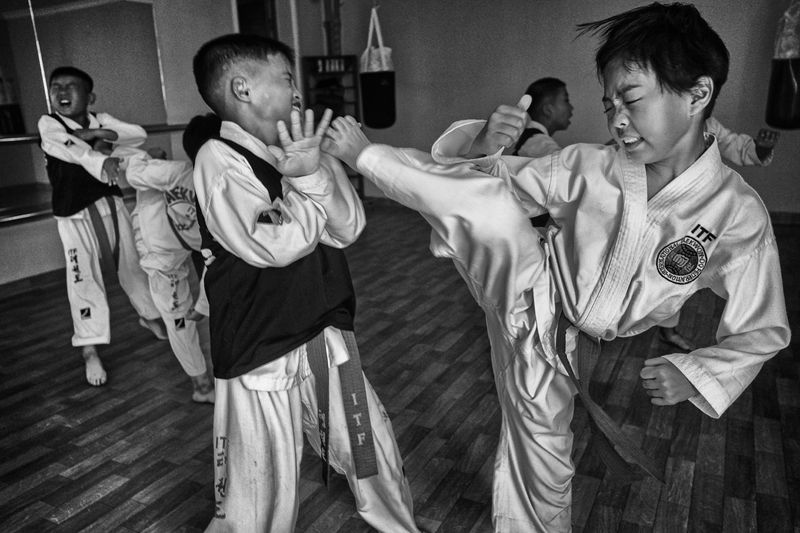
Students from Mirae Primary School in Pyongyang spar.  A young girl fends off her adversary in self defense or  hosensul with an energetic yop chagi (lateral kick). The fullness of the dobok, the Taekwondo uniform, does not interfere with movement even with legs fully outstretched. This kick of measured and controlled aggressiveness, delivered with intensity, is often used in competition and for breaking materials. Although the origins of martial arts are shrouded in mystery, since time immemorial men have used their hands and feet for self-protection. Influenced by a combination of historical events in Korea and Japanese traditions, the modern incarnation of Korea’s national martial art Taekwondo ("way of kick and fist") was created in 1955 by General Choi Hong-hi. Born in what is now North Korea, his idea was to develop a specific martial art to demonstrate the spirit and wisdom of the Korean nation to the outside world. Taekwondo is extremely popular in North Korea. It is taught in every school and is part of the daily sports and health routine of all DPRK citizens. After 50 years of existence, the art of kicks has 60 million practitioners in more than 120 countries. Taekwondo became a medal sport at the Sydney 2000 Olympic Games.
© Alain Schroeder - Image from the Taekwondo North Korea Style photography project
i

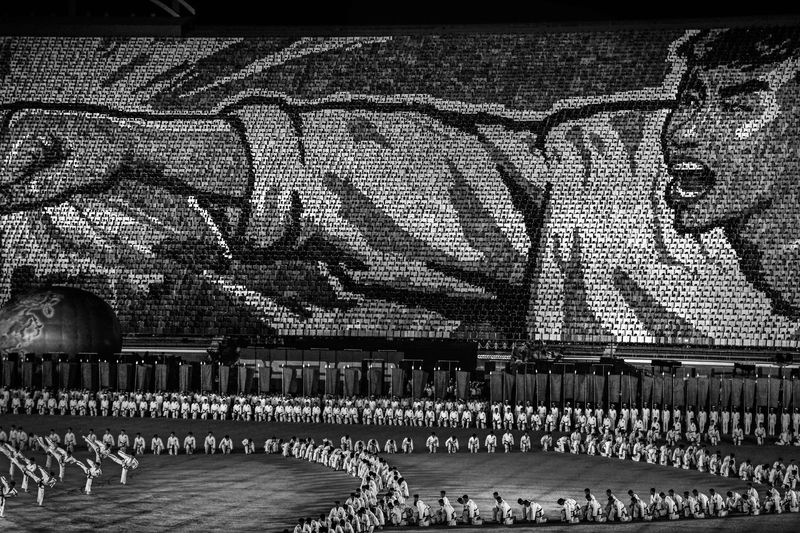
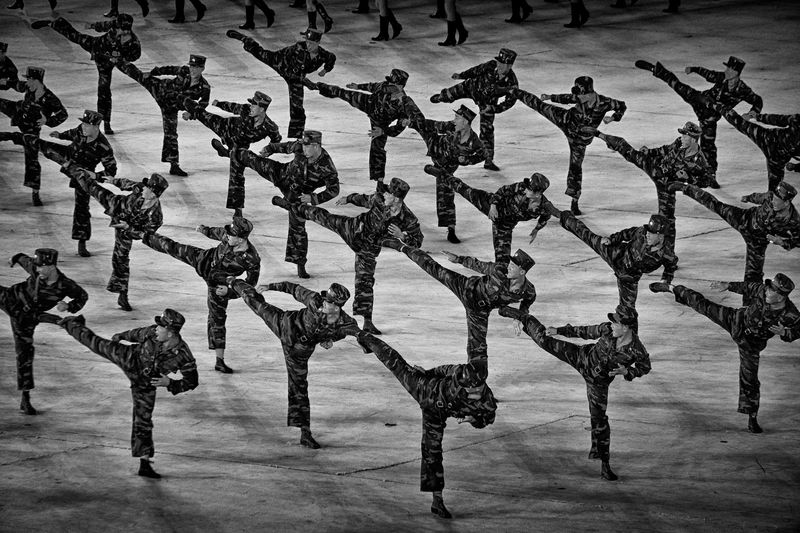
During the Mass Games, the large number of athletes and soldiers on the field is intended to emphasize movement as a group over individual performance. Emblematic Taekwando kicking techniques, such as chop yagi, pictured here, have been widely used by the military in the DPRK since 1955, and have spread all over the world in both military and civil society. For the first time since 2013, and in honor of the 70th anniversary of the creation of North Korea on September 9, 1948, the Mass Games, also known as the Arirang Festival, are held at the May Day Stadium in Pyongyang, one of the five largest stadiums in the world. Following months of repetition, 100,000 volunteer dancers, athletes, soldiers, students and children participate in a 90-minute event showcasing numerous tightly choreographed scenes synchronized to music. Although the origins of martial arts are shrouded in mystery, since time immemorial men have used their hands and feet for self-protection. Influenced by a combination of historical events in Korea and Japanese traditions, the modern incarnation of Korea’s national martial art Taekwondo ("way of kick and fist") was created in 1955 by General Choi Hong-hi. Born in what is now North Korea, his idea was to develop a specific martial art to demonstrate the spirit and wisdom of the Korean nation to the outside world. Taekwondo is extremely popular in North Korea. It is taught in every school and is part of the daily sports and health routine of all DPRK citizens. After 50 years of existence, the art of kicks has 60 million practitioners in more than 120 countries. Taekwondo became a medal sport at the Sydney 2000 Olympic Games.
© Alain Schroeder - Image from the Taekwondo North Korea Style photography project
i

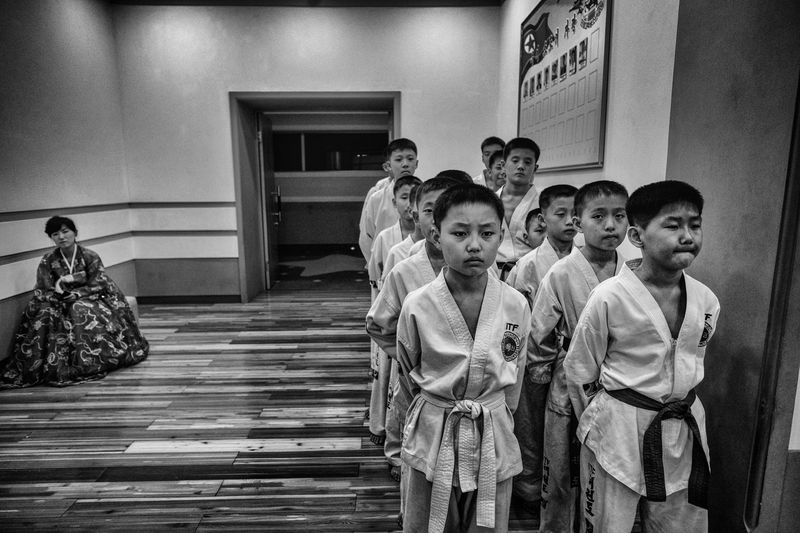
At Mangyongdae Children’s Palace the best students can participate in extra curricular activities such as sports. In the corner of the dojang (Taekwondo training room), a group of young trainees attentively follow the workout of older students, under the watchful eye of the supervisor, who is wearing a hanbok, the traditional Korean dress. Although the origins of martial arts are shrouded in mystery, since time immemorial men have used their hands and feet for self-protection. Influenced by a combination of historical events in Korea and Japanese traditions, the modern incarnation of Korea’s national martial art Taekwondo ("way of kick and fist") was created in 1955 by General Choi Hong-hi. Born in what is now North Korea, his idea was to develop a specific martial art to demonstrate the spirit and wisdom of the Korean nation to the outside world. Taekwondo is extremely popular in North Korea. It is taught in every school and is part of the daily sports and health routine of all DPRK citizens. After 50 years of existence, the art of kicks has 60 million practitioners in more than 120 countries. Taekwondo became a medal sport at the Sydney 2000 Olympic Games.
© Alain Schroeder - Image from the Taekwondo North Korea Style photography project
i

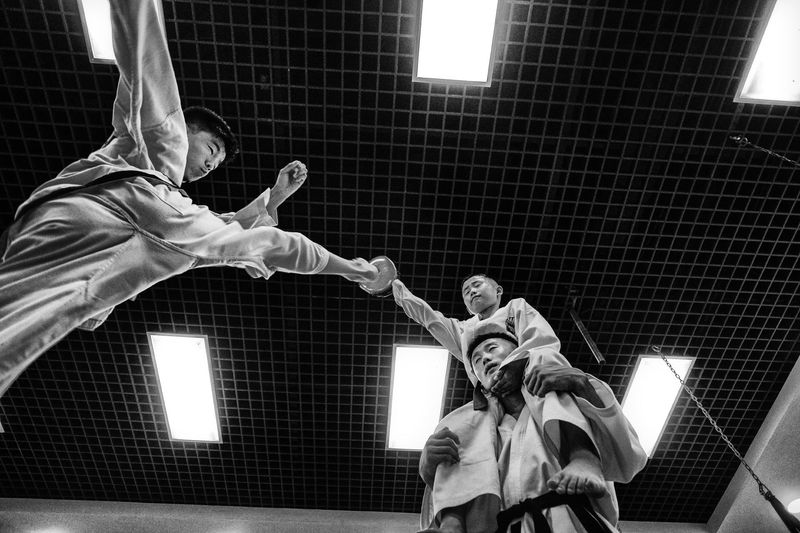
Taekwando can be translated as the way (do) of kicks (tae) and punches (kwon) and is famous for its spectacular, characteristic backspin and jump kicks immortalized in many action films. Here in training, the athlete executes a nopi chagi, a flying high front kick against a training pad to improve strike precision and reaction time. Although the origins of martial arts are shrouded in mystery, since time immemorial men have used their hands and feet for self-protection. Influenced by a combination of historical events in Korea and Japanese traditions, the modern incarnation of Korea’s national martial art Taekwondo ("way of kick and fist") was created in 1955 by General Choi Hong-hi. Born in what is now North Korea, his idea was to develop a specific martial art to demonstrate the spirit and wisdom of the Korean nation to the outside world. Taekwondo is extremely popular in North Korea. It is taught in every school and is part of the daily sports and health routine of all DPRK citizens. After 50 years of existence, the art of kicks has 60 million practitioners in more than 120 countries. Taekwondo became a medal sport at the Sydney 2000 Olympic Games.
© Alain Schroeder - Image from the Taekwondo North Korea Style photography project
i

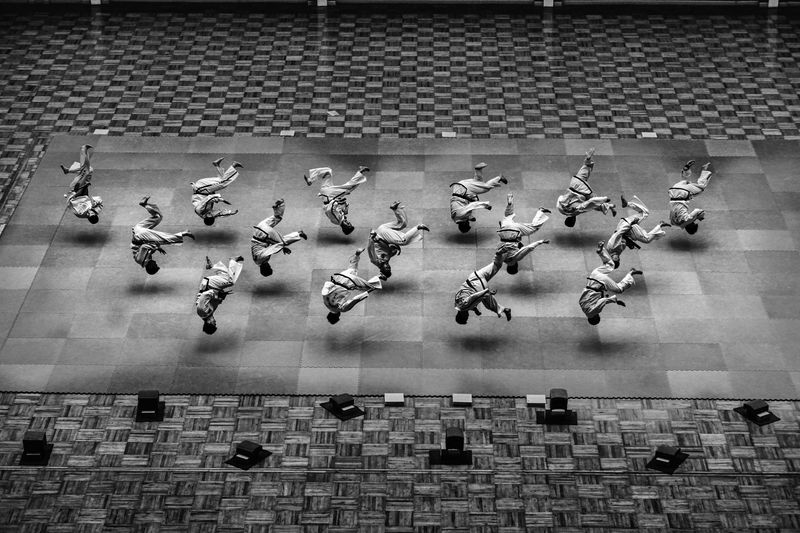
At the Taekwando Palace in Pyongyang, a group of athletes simultaneously execute a tul, a series of offensive and defensive techniques against one or several virtual adversaries. A tul is the equivalent of a kata or pattern of moves in Karate. There are 24 tuls, one for every hour of the day. In the foreground, stacks of tiles and (30 x 30 cm) pieces of wood that the athletes will break with their hands and feet in order to demonstrate kyok-pa, the art of breaking boards, bricks and tiles. Although the origins of martial arts are shrouded in mystery, since time immemorial men have used their hands and feet for self-protection. Influenced by a combination of historical events in Korea and Japanese traditions, the modern incarnation of Korea’s national martial art Taekwondo ("way of kick and fist") was created in 1955 by General Choi Hong-hi. Born in what is now North Korea, his idea was to develop a specific martial art to demonstrate the spirit and wisdom of the Korean nation to the outside world. Taekwondo is extremely popular in North Korea. It is taught in every school and is part of the daily sports and health routine of all DPRK citizens. After 50 years of existence, the art of kicks has 60 million practitioners in more than 120 countries. Taekwondo became a medal sport at the Sydney 2000 Olympic Games.
© Alain Schroeder - Image from the Taekwondo North Korea Style photography project
i

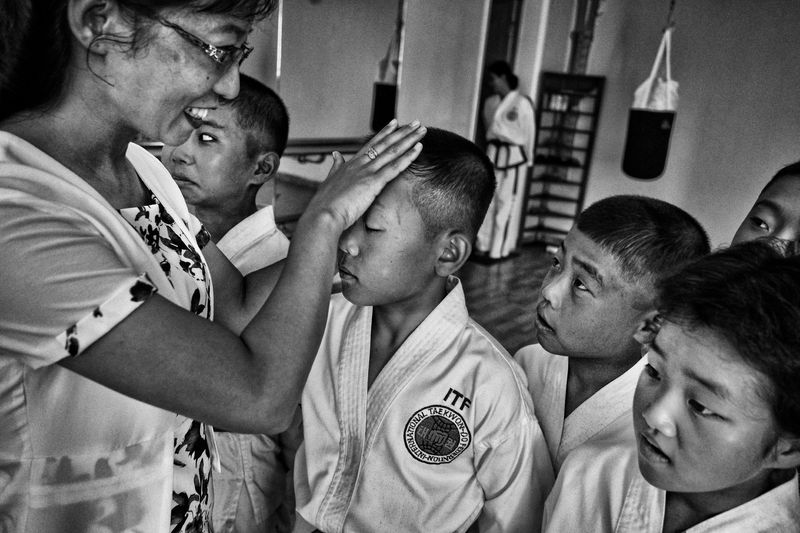
At the end of the demonstration, having followed the entire presentation, the headmistress of Pyongyang’s Mirae Primary School congratulates and comforts the children who are between 7 and 12-years-old. Although the origins of martial arts are shrouded in mystery, since time immemorial men have used their hands and feet for self-protection. Influenced by a combination of historical events in Korea and Japanese traditions, the modern incarnation of Korea’s national martial art Taekwondo ("way of kick and fist") was created in 1955 by General Choi Hong-hi. Born in what is now North Korea, his idea was to develop a specific martial art to demonstrate the spirit and wisdom of the Korean nation to the outside world. Taekwondo is extremely popular in North Korea. It is taught in every school and is part of the daily sports and health routine of all DPRK citizens. After 50 years of existence, the art of kicks has 60 million practitioners in more than 120 countries. Taekwondo became a medal sport at the Sydney 2000 Olympic Games.
© Alain Schroeder - Image from the Taekwondo North Korea Style photography project
i

For the first time since 2013 and in honor of the 70th anniversary of the creation of North Korea on September 9, 1948, the Mass Games, also known as the Arirang Festival, are held at the May Day stadium in Pyongyang, one of the five largest stadiums in the world. In addition to the 100,000 volunteer participants on the field performing during the 90 minute event, 17000 students seated in the grandstand facing the public execute a series of images using a card stunt technique whereby following specific directions, with military precision, all 17000 participants simultaneously unfold colored panels to form sweeping grand images. Each person represents a pixel in the overall image. Behind the Taekwondo athletes performing on the field, the image represents a characteristic move of this national sport; ap joomuk kaunde jirugi, a fore-fist middle section punch.  Although the origins of martial arts are shrouded in mystery, since time immemorial men have used their hands and feet for self-protection. Influenced by a combination of historical events in Korea and Japanese traditions, the modern incarnation of Korea’s national martial art Taekwondo ("way of kick and fist") was created in 1955 by General Choi Hong-hi. Born in what is now North Korea, his idea was to develop a specific martial art to demonstrate the spirit and wisdom of the Korean nation to the outside world. Taekwondo is extremely popular in North Korea. It is taught in every school and is part of the daily sports and health routine of all DPRK citizens. After 50 years of existence, the art of kicks has 60 million practitioners in more than 120 countries. Taekwondo became a medal sport at the Sydney 2000 Olympic Games.