Scomparsa/Disparition by Sibylle Duboc at Mucho Mas!
-
Open13 Feb - 5 Apr 2025
-
Link
- Location Turin, Italy
Sibylle Duboc was invited to Turin by Mucho Mas! to continue her research on climate change and the anthropization of the Alpine landscape in the archives of the National Mountain Museum, during a residency period in October 2024.
Overview
The research project was conceived by Mucho Mas! in collaboration with the National Mountain Museum (TO) and the Musee des Merveilles (Tende) and supported by the Compagnia di San Paolo Foundation and the CRT Foundation. Sibylle will also present the performance The Glacier March on Saturday 5 April 2025 as part of the Walking Mountains Social Walks program.
The exhibition will be activated by a talk on April 4 on the occasion of the finissage, with speeches by Andrea Lerda, curator of the National Mountain Museum of Turin, and Silvia Sandrone, director of the Musee des Merveilles (Tende), as well as the presence of the artist Sibylle Duboc and the founders of Mucho Mas! Luca Vianello and Silvia Mangosio.
Scomparsa/Disparition includes a series of works created over the past year in a series of residencies during which the artist focused on researching the changes and anthropization of the Alpine landscape.
Like reflections of landscapes transformed by man, the works that Duboc creates echo the damage inflicted on the environment. They therefore evoke the consequences of our era, the Anthropocene, in which the natural resources used daily will inevitably disappear. Sibylle Duboc's creations seek to question our gestures, our consumption, our lifestyles and our relationship with the visible. Constituting a sort of formal game between the industrialization of man and the designs of nature, her works highlight an important transformation of the landscape, through the exploitation of natural resources. These works take the form of sculpture, photographic experiments, videos and performances: they question our link with nature by showing us a fragile environment and a land threatened by human action. Connecting geological phenomena with our industrial productivist systems to highlight the perspectives of an anthropized nature, her works tell of ruins that contain inverted temporalities, they are fragmentations of the present that lead us towards alternative stories, towards vestiges of the current world. They are the countdown to a chimeric archeology, fictions that take us beyond the object, towards dissolved landscapes, where the edge of the abyss seems to crumble slowly to lead us towards a state of chaos.
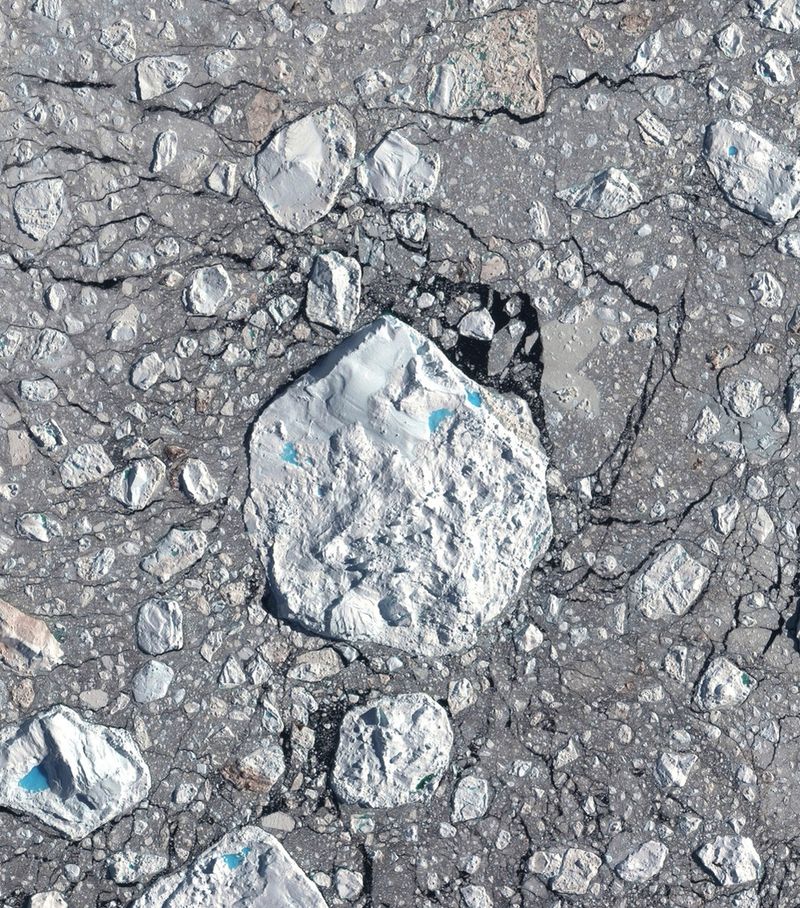
The Scomparsa/Disparition exhibition inverts the narrative of humanity's dominion over the geological history of the Earth: here the mineral world reigns. While revealing its own anthropization, the rock announces the end of the era of the domestication of its mountains. From here emerge works that cross the melting of the glaciers of the Alps, the dissolution of the Arctic, the flow of the millennial rock engravings that proliferate in the Valley of Wonders. Each of these petrifications refers to our inevitable slide towards an uninhabitable land. They reveal the future of our civilization: that is, its absorption into the geological history of the Earth. They remind us that when the era of the anthropization of the world comes to an end, only the rock will remain to engrave the trace of our passage in its sediments.
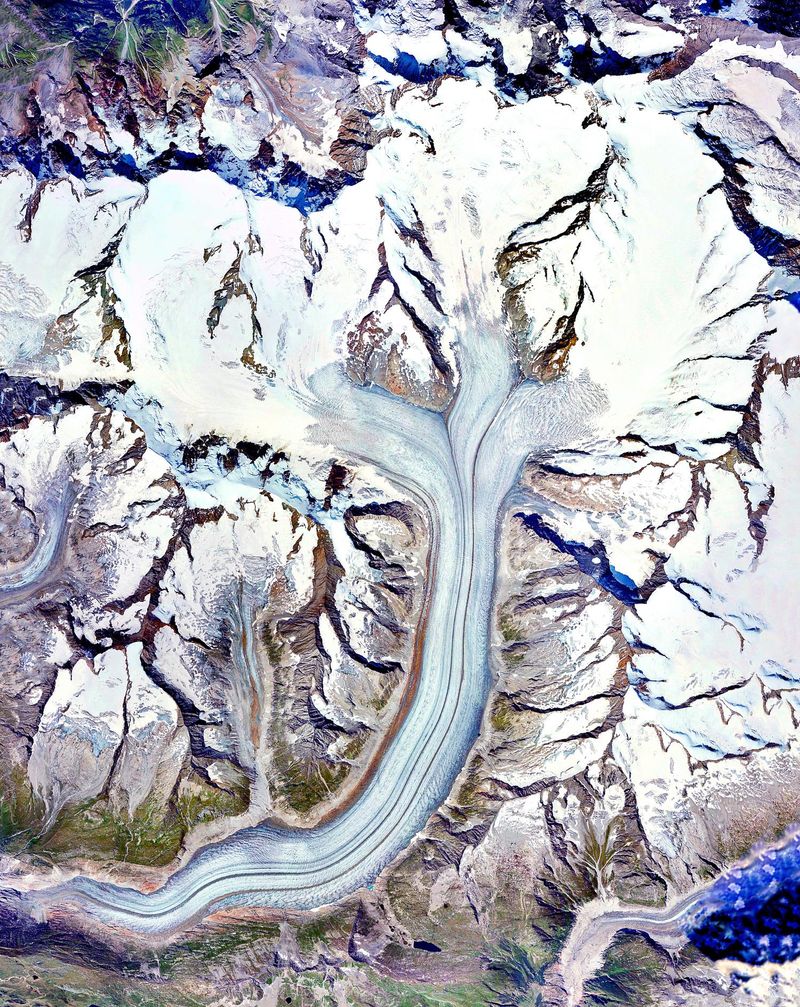
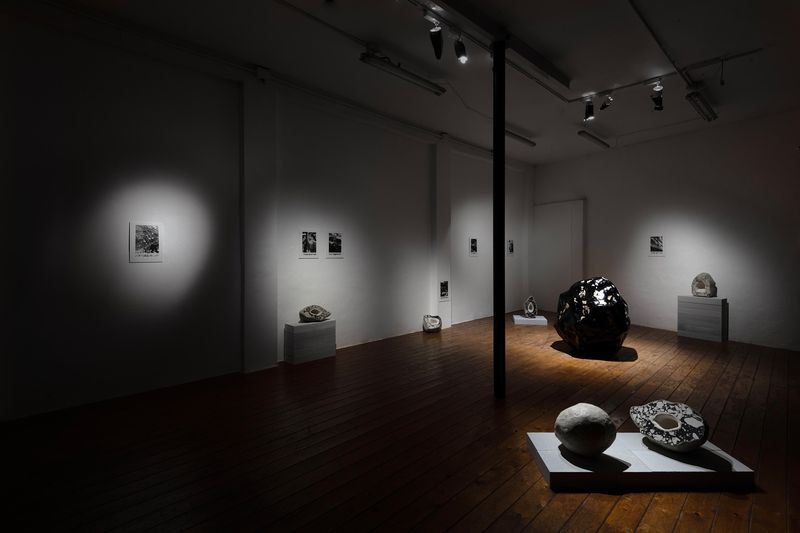
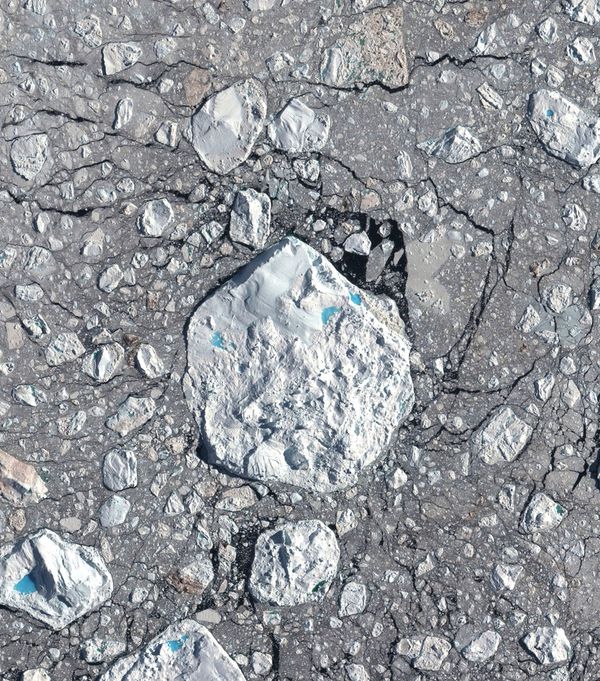
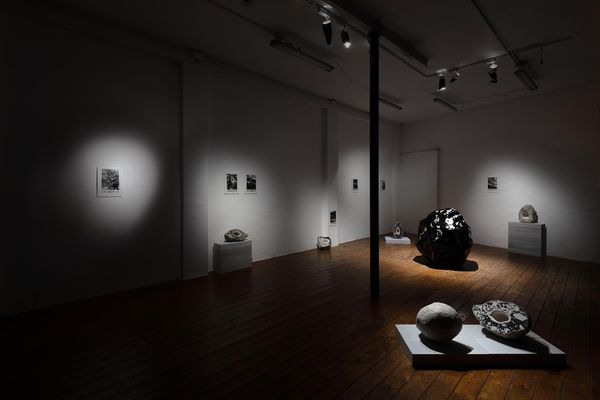
Concrete sculptures, on which the artist prints images relating to the melting of glaciers taken from Google Earth in a darkroom with photosensitive emulsion, mimic the shape of empty geodes. These are contrasted by a large gypsum boulder on which the signs of rock engravings are carved, evidence of the passage of man since the dawn of civilization. The areas on which Duboc concentrated her research have been anthropized since ancient times: on the mountains, there are signs of the passage of man and his journey, which continues to this day in an increasingly evident way. Together with the sculptures, the exhibition features photographs of the rock engravings found in the Valley of Wonders, petroglyphs that date back to 3,500 BC, presented as modern digital traces of our presence in the mountain world. To extract us from our visual world made of screens and virtual data, the stone materializes the smartphone photograph through the physical-chemical reaction and carves the satellite image into a solid, heavy and unchangeable volume. Thus the mineral world draws on our images to fossilize the vernacular and make its forms palpable.