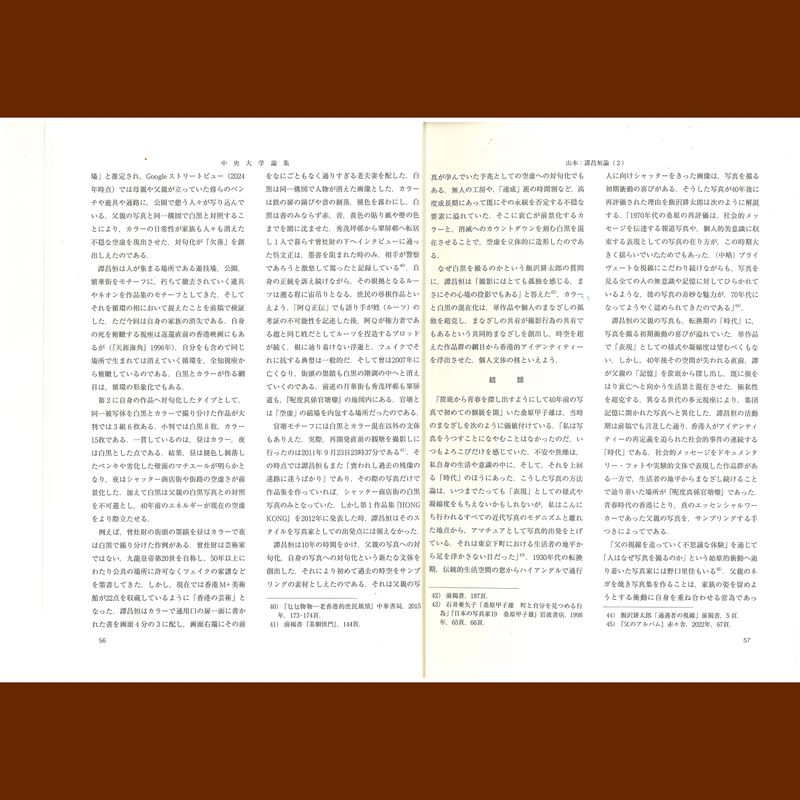
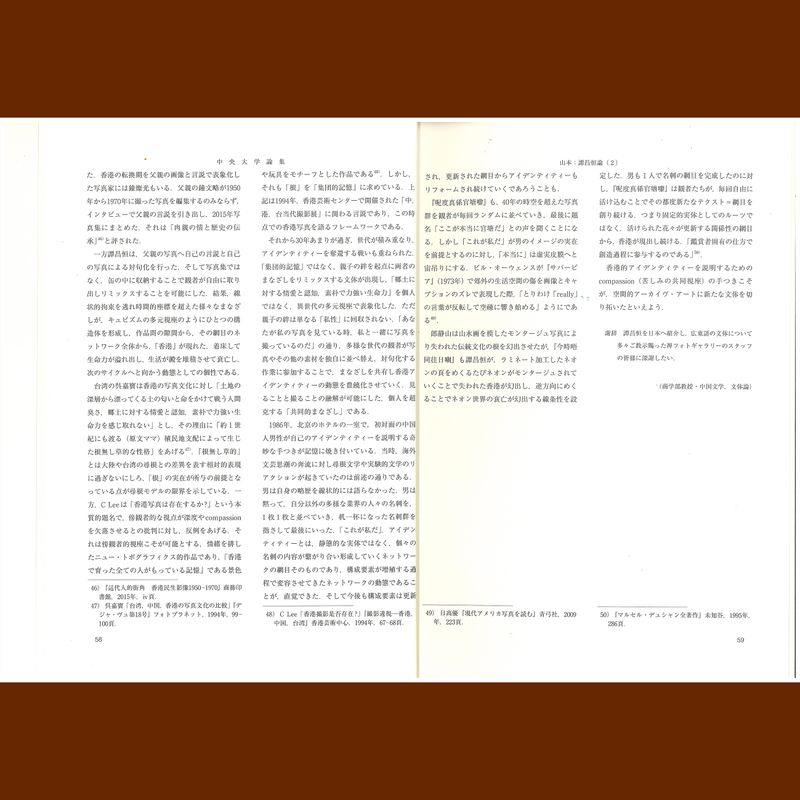
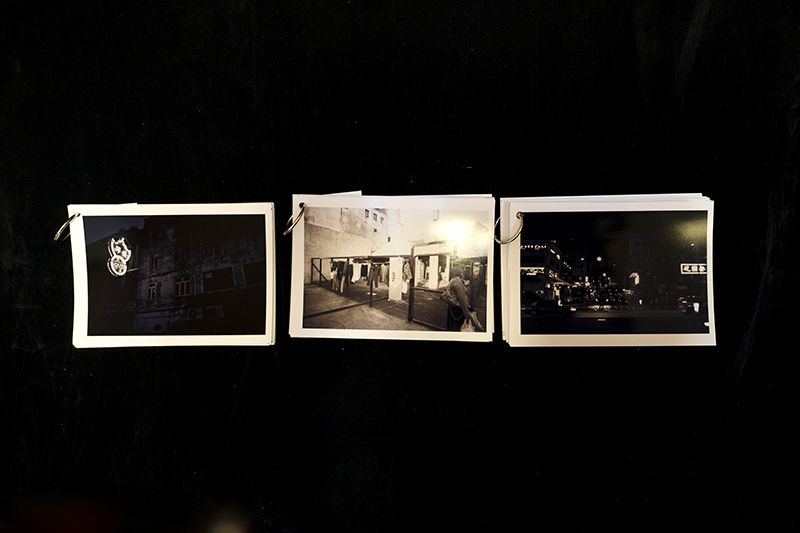
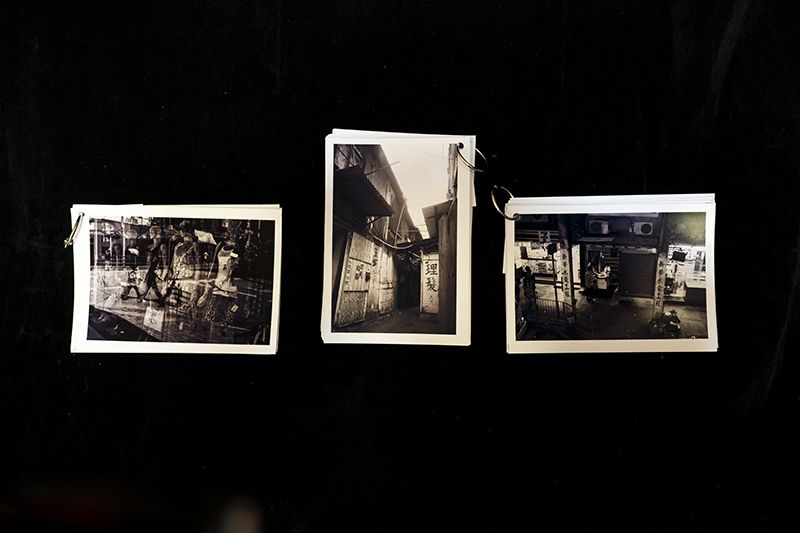
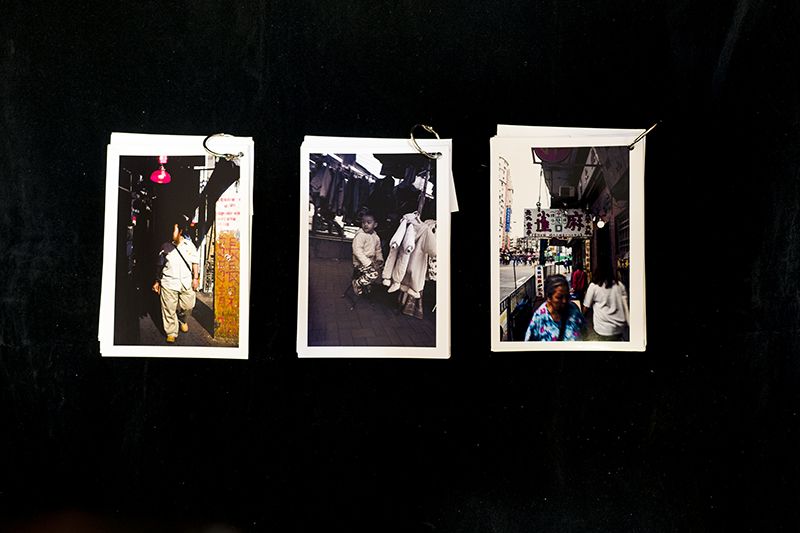
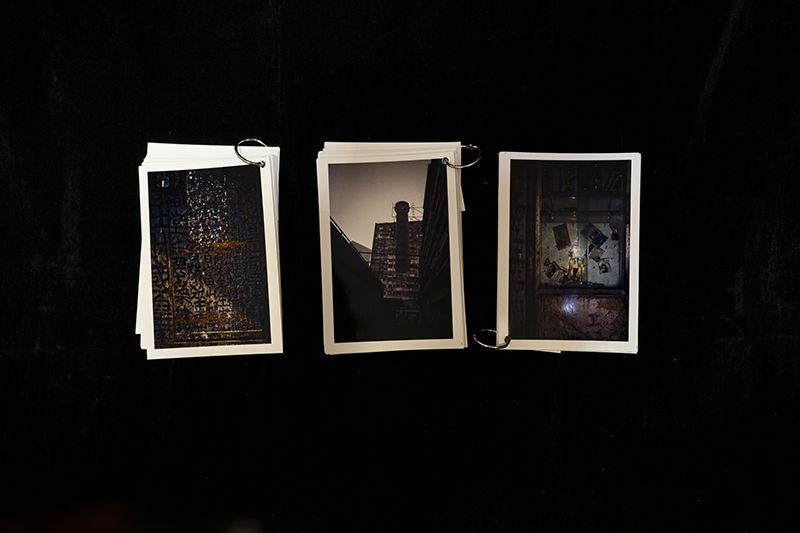
Name: Akira YAMAMOTO Professor, Faculty of Commerce (Stylistics) Title: On Hang Tam (2) —The Topology of Spatial Archive Art in Post-"Jishi Sheying" (Chinese Documentary Photography)—
-
Dates2025 - 2026
-
Author
- Topics Photobooks
Name: Akira YAMAMOTO Professor, Faculty of Commerce (Stylistics) Title: On Hang Tam (2) —The Topology of Spatial Archive Art in Post-"Jishi Sheying" (Chinese Documentary Photography)—
Name: Akira YAMAMOTO
Professor, Faculty of Commerce (Stylistics)
Title:
On Hang Tam (2)
—The Topology of Spatial Archive Art in Post-"Jishi Sheying" (Chinese Documentary Photography)—
English Title:
The Style of Hang Tam
A Study on the Non-linear Arrangement of Archive Artworks in Chinese Post-Documentary Photography
[Requested Layout: Horizontal, 23983]
On Hang Tam (2)
—The Topology of Spatial Archive Art in Post-"Jishi Sheying" (Chinese Documentary Photography)—
Akira Yamamoto
"When you are looking at my photographs, you are taking photographs with me."
—Hang Tam, *HONG KONG* 1)
Introduction
The more one seeks, the more "memory" remains out of reach. "Memory" is the root that generates the identity of the self and the community. The moment one believes those roots to be a physical reality, one falls into the gravitational field of reification, and the exit from the labyrinth vanishes. This is because postulating roots as a linear process of causality forces one to wander that labyrinth indefinitely. If so, what kind of language and imagery can fly out of the labyrinth and give form to "memory"?
When a place is about to be lost, the doors to the labyrinth open. These are the alleys about to disappear due to redevelopment; it is the Hong Kong about to be handed over to China.
"No matter what you say, this city is loaded with the memories of this place. If I walk through this city, I might be able to return to the past, and if I go beyond the past, I might reach the moment this city was born, the moment of our birth." 2) When pressed for a definition of identity, tracing back to one's roots is a typical reaction. The protagonist of Dung Kai-cheung's novel *The Rise and Fall of Wing Shing Street* also examines the history of Wing Shing Street—the roots where his grandparents settled—as the Hong Kong handover approaches. However, the more he examines it, the more he "feels himself falling into a bottomless pit, lost in a phantom world of memory and written description." 3) Mo Yan, a native of Shandong Province, found his roots in the "Red Sorghum" series in the fields of red sorghum—a collective lifeform spreading like a sea of blood to the horizon. Taking the existence of roots as a given premise enabled a magic-realist chronicle. 4) However, to "search for roots in concrete land created by reclaiming the sea," 5) one must investigate "archives" such as old photographs, maps, newspapers, and family memories. Ultimately, the more one investigates, the harder it becomes to distinguish truth from fiction, and he is even told by his father that Wing Shing Street never existed in the first place. Dung Kai-cheung expressed this sense of suspension as "nihility."
Inuohiko Yomota classifies the reactions to the Hong Kong handover in cinema, defining one of the types as follows: "Everything appears to be an object of retrospection. But in the end, one reaches nowhere, merely wandering the labyrinth of afterimages of a lost past." 6) This reaction of seeking roots is not limited to Hong Kong. When national culture, shaken by the Cultural Revolution and the Reform and Opening-up, was forced to redefine identity, what appeared on the mainland was "Xungen Wenxue" (Root-Seeking Literature), of which the "Red Sorghum" series started in 1986 is a part.
From narrow lane to narrow lane, it is as if entering a time tunnel. A photograph surfaces in my mind: my father holding me, only one year old, sitting in a park. I once heard my mother say that our family lived in Kwun Tong when I was about one or two years old, but I cannot remember it at all. When photographing this place, I had no memories of the past, nor did I feel even a hint of nostalgia.
Like the protagonist of *The Rise and Fall of Wing Shing Street*, Hang Tam wanders from one narrow alley to another in his hometown, which is on the verge of disappearing due to redevelopment. Following the 2011 "Energizing Kowloon East" initiative, Kwun Tong was slated for a structural transformation from an industrial area to a commercial and offshore trade hub, prompting an influx of documentary photographers to capture the vanishing spaces. At that point, Hang Tam was merely one of them. However, in the photo essay published in 2020, the cited passage that verbalizes this experience reveals the emergence of a distinct personal style. While wandering the labyrinth, he experiences a "time slip," arriving at a root-image of his father sitting in a park holding his one-year-old self. Yet, that specific photograph does not exist. While a father-child photo is included in *It's really is Kwun Tong*, the father is actually holding a young girl 8). My mother testifies that we certainly lived there until I was about two. However, I cannot remember it. Even while photographing, there is no memory. No nostalgia. Through the adversarial linking of clauses and the accumulation of negations, the outlines once drawn are erased one after another. A reciprocal style of language and imagery was formed, suspended in mid-air the more it traces back to its roots.
How, then, was Hang Tam able to break away from the labyrinth and use the word "Truth" (真) in *It's really is Kwun Tong*? And why did that style summon spatial archive art?
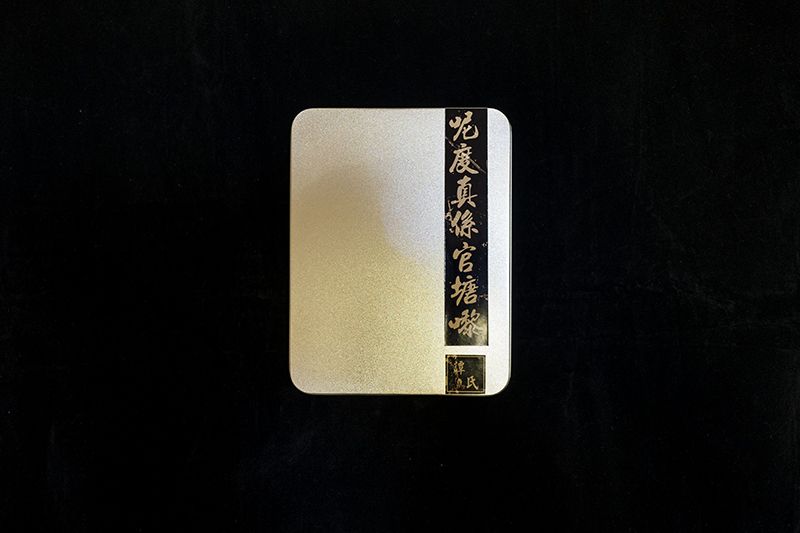
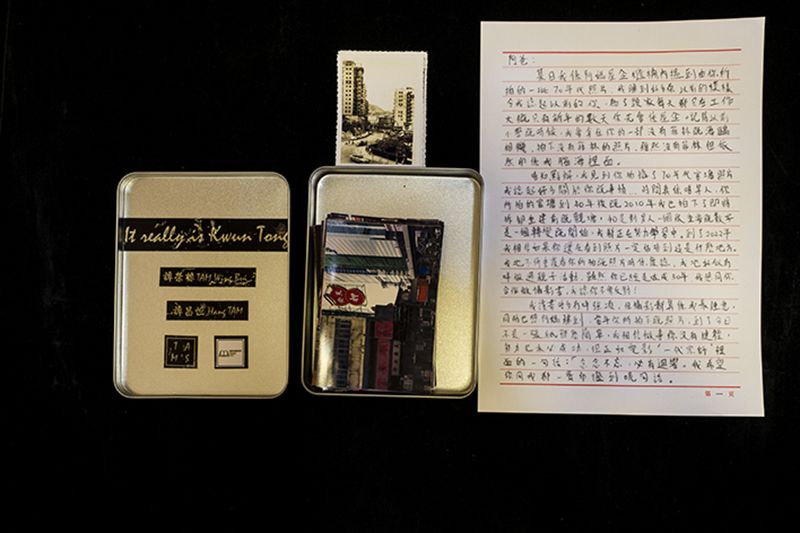
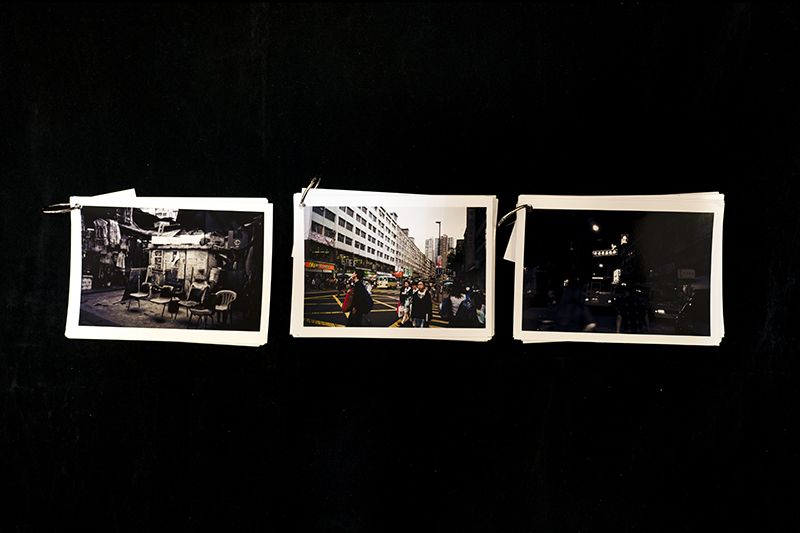
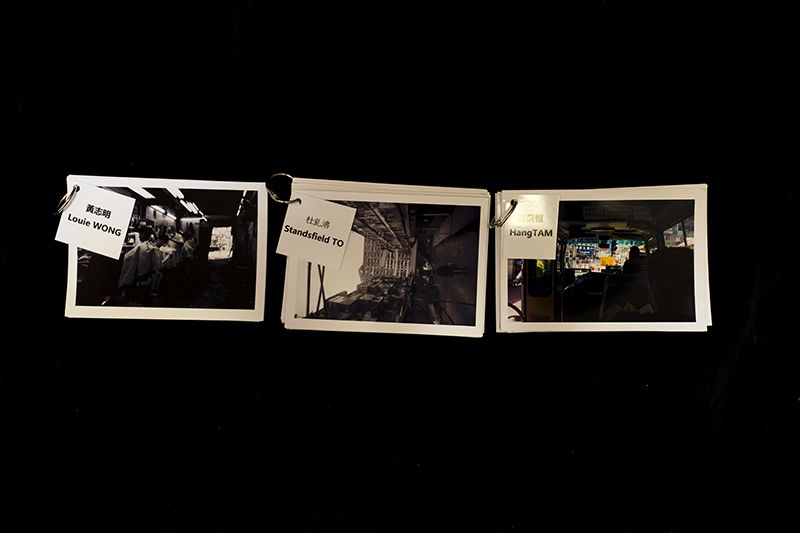
*It's really is Kwun Tong* consists of seven elements. First, 33 photographs taken by his father 40 years ago; second, 32 photographs taken 40 years later by Hang Tam of the same or similar subjects (hereafter referred to as "couplets"); third, a handwritten letter addressed to his father; fourth, an English translation of that letter; fifth, a map of Kwun Tong; sixth, two rent receipts from different periods; and seventh, a cloth printed with two works and the colophon—all of which are contained within a tin can.
This methodology is, in a sense, traditional. Duchamp, who established a form of expression that deconstructed ready-made objects and made them correspond with words in the 1910s, called this "Readymade." Since the 1970s, a genre has existed within conceptual art that takes past memory as its theme, collecting and displaying fragments as "traces." Christian Boltanski, in particular, does not merely utilize "traces" but possesses a fictionality that creates them. In fact, in his *Research Showcase* series, he exhibited various groups of "traces" other than his own photographs in glass cases 9). Beyond this, figurative memories requested styles other than linear display, such as being placed in biscuit tins. Boltanski expressed the joy of acquiring that style as follows: "I became an artist of space" 10). However, as a result of piling up a vast number of cans in an attempt to formalize the collective memory of strangers, the cans were forced to be empty inside.
This trend of treating archives as something with value beyond historical data is called the "archival turn," a movement that occurred globally and across disciplines such as anthropology, sociology, psychology, and art from the end of the 20th century to the beginning of the 21st century 11).
The viewer of *It's really is Kwun Tong* opens the tin and arranges the "traces" randomly, much like the process of the protagonist in *The Rise and Fall of Wing Shing Street* searching for roots that do not exist in his own memory. However, a receipt from 1971 bears the name Tam Ming, which differs from his father's name, Tam Wing-biu. While the 1977 receipt does indeed bear his father's name, Hang Tam was born in 1978, so it does not serve as corroboration for his mother's memory. The paper quality, stamps, and even memos on the back are reproduced. Yet, the very act of feigning authenticity is a fiction. The map is titled "Detailed Map of Kwun Tong and Sau Mau Ping." It is a cutout of a portion of a Kwun Tong bus route map produced by the *Wah Kiu Yat Po* in 1975. However, the very map intended to guarantee certainty is a type of fiction abstracted from reality, just as it constructed the labyrinth in *The Rise and Fall of Wing Shing Street*.
There is no myth of origin in a place constructed through land reclamation and migration. The very idea of "root-seeking" (Xungen) presupposes a substantive root unique to Hong Kong and summons the continuous time of history. If such a linear movement from a singular perspective is what causes the labyrinth to appear, then what kind of multi-dimensional perspective can overcome linearity and discover—or create—a different kind of "identity" from "roots"?
This paper stands at the intersection of my twelve previous essays that evaluated innovations in visual style within documentary photography, and my ten essays that elucidated the role played by the reciprocal relationship between linguistic and visual stylistic innovations 12). Second, it is positioned as the second paper discussing the style of Hang Tam, who realized "photography" through the reciprocal movement of language and imagery. In the previous paper, I utilized the definition of archive art—"quoting existing texts, images, and objects and presenting them in a serial format of linked identical forms (...) and through these operations and modifications, attempting to create historical information, specifically alternative knowledge or counter-memory that differs from conventional wisdom" 13)—to assign expression-historical value to the personal style in the bound photobook *Time have change*, which cannot escape linearity. This paper evaluates the expression-historical value of the reciprocal movement between linguistic and visual styles that brought about the evolution into *It's really is Kwun Tong* the following year—that is, the opening of a Hong Kong-style expression in spatial archive art.
### 1. The Linguistic Style of *It's really is Kwun Tong*
Hang Tam "intermingled" dialect (Cantonese) and Standard Mandarin. If it were "alternation," it would be similar to the approach taken by Taiwanese Nativist literature since the 1960s, which used Taiwanese Hokkien in dialogue or specific vocabulary to "describe the reality of Taiwan more realistically" 14). However, Hang Tam intermingled them within the narrative prose itself, and did so without adhering to specific norms.
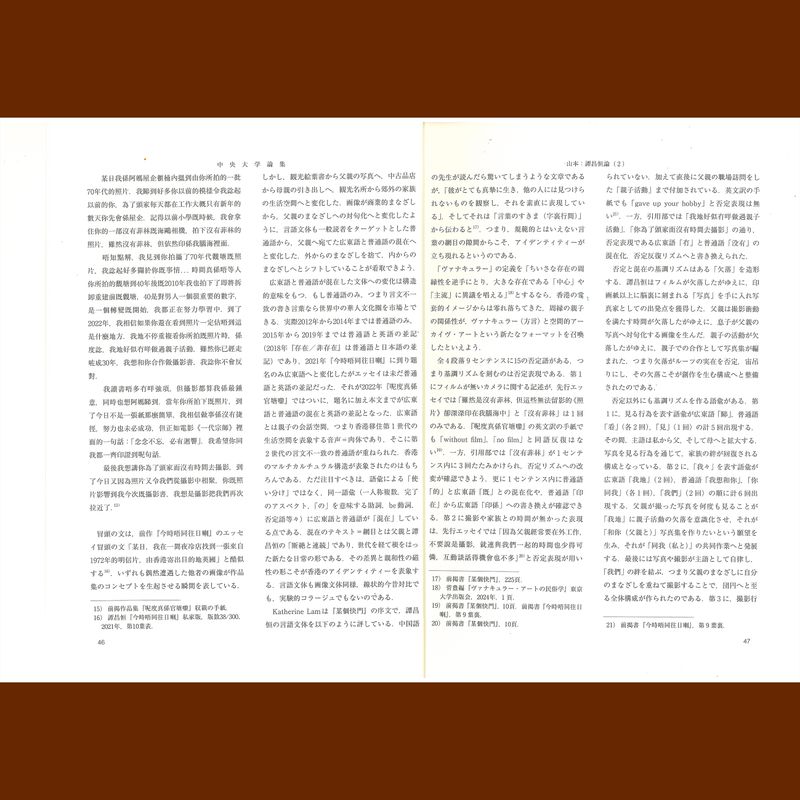
> One day, in a drawer at my mom’s place, I found a batch of photos from the 70s taken by you. Seeing many images of how you used to look reminded me of the person you were back then; you worked every day for the family, and probably only spent a few days at home during the New Year. I remember back in primary school, I would hold one of your Seagull cameras that had no film in it and take "photos" without film. Even though there was no film, those images are still imprinted in my mind.
> I don’t know why, but seeing the photos you took of Kwun Tong in the 70s makes me think of many things about you... Time really waits for no one. Forty years later, in 2010, I also photographed the Kwun Tong that was about to be demolished and redeveloped. Forty is a very important number for a man; it is the beginning of a transformation, and I am working hard to learn. By 2022, I believe if you were still here to see these photos, you definitely wouldn't guess what kind of place this is. When we repeatedly look at the photos you took, we think to ourselves that we didn't seem to have many parent-child activities. Even though you’ve been gone for 30 years, I want to collaborate with you to make a photography book; I don’t think you would object.
> I didn’t study much and don’t have many strengths, but photography is what I like most, and I also want Mom to see it. The photos you took back then are more than just pieces of paper today. I believe there are no shortcuts in doing things—hard work might not lead to success, but as a line in the movie *The Grandmaster* says: "Keep the faith, and there will be an echo." I hope both you and I can witness the truth of these words together.
> Finally, I want to say that while you didn’t have time for photography because of the family, today, because of these photos, we are reunited through photography once again. Your photos have influenced my photography book this time; I think it is photography that has brought us closer together again. 15)
The opening sentence is strikingly similar to the beginning of the essay in his previous work, *Time have change*: "One day, I found a postcard from 1972 in a second-hand shop, sent from Hong Kong to the UK" 16). Both describe the moment a chance encounter with someone else's image gives rise to the concept of a collection. However, there is a shift: from a tourist postcard to a father's photograph, from a thrift store to a mother's drawer, and from a tourist attraction to a suburban family's living space. Just as the imagery changed from a commercial gaze to a "couplet-style" dialogue with his father's gaze, the linguistic style shifted from Standard Mandarin targeting a general readership to an intermingling of Cantonese and Mandarin addressed to his father. We can observe a shift away from an external gaze toward an internal one.
This shift to a style where Cantonese and Mandarin are intermingled holds structural significance. If he used only Standard Mandarin—a written language that diverges from spoken Cantonese—he could market to the entire global Sinophone world. Indeed, from 2012 to 2014, he used only Mandarin; from 2015 to 2019, he used Mandarin and English side-by-side (with 2018's *Existence/Non-existence* featuring Mandarin and Japanese); and in 2021's *Time have change*, only the title changed to Cantonese while the essay remained in Mandarin and English. Finally, in 2022's *It's really is Kwun Tong*, not only the title but the main text became an intermingling of Cantonese and Mandarin alongside English.
Cantonese represents the conversational space between parent and child—the voice and physicality of the first generation of Hong Kong immigrants—upon which the second generation's written Standard Mandarin is layered. This clearly represents Hong Kong's dual-cultural structure. What is noteworthy, however, is not the "alternation" based on vocabulary, but the "intermingling" of Cantonese and Mandarin within the same grammatical categories (first-person plurals, perfective aspects, particles meaning "of," the copula "to be," negations, etc.). This intermingled text/mesh represents the disconnect and continuity between the father and Hang Tam; it is a new form of daily life that has taken root over generations. The shape of the magnetism between these differences and affinities represents Hong Kong's identity. Like his visual style, his linguistic style is neither a linear past-present comparison nor an experimental collage.
In the preface to *A Certain Shutter*, Katherine Lam evaluates Hang Tam’s linguistic style as follows: while the writing might shock a Chinese teacher, "he lives very sincerely, observes things others cannot find, and expresses them honestly." She notes that this is conveyed "between the lines" (字裏行間) 17). In other words, it is precisely from the gaps in this non-normative linguistic mesh that identity emerges.
Defining "vernacular" as "taking advantage of the marginality of a small existence to challenge the 'center' or 'mainstream' that is a large existence"—
18. If we adopt this definition, it can be said that the peripheral parent-child relationship—which had slipped through the cracks of conventional imagery of Hong Kong—summoned a new format: the vernacular (dialect) and spatial archive art.
Across the four paragraphs and nine sentences of the text, there are fifteen negative terms. In other words, the underlying rhythm is carved by expressions of negation. First, regarding the description of the camera without film: in the previous essay, "no film" appeared only once: "Although there was no film, these 'photos' that could not be captured were deeply imprinted in my mind." Even in the English translation of the letter in *It's really is Kwun Tong*, there is no tautological repetition, using "without film" and "no film" only once each 19). In contrast, the cited passage repeats "no film" (沒有菲林) three times within a single sentence, confirming a deliberate modification to create a rhythm of negation. Furthermore, one can observe the intermingling of the Mandarin particle *de* (的) and the Cantonese *ge* (既) within a single sentence, as well as the rewriting of the Mandarin "imprinted in" (*yin zai* 印在) to the Cantonese *yin hai* (印係).
Second, regarding the expression of the lack of time for photography or family: in the previous essay, no negative expressions were used: "Because my father often had to work away from home, let alone photography, even the time he spent with us was pitifully short, and there were few opportunities for interactive conversation" 20). Additionally, a "parent-child activity" involving a visit to the father's workplace was appended immediately after. In the English translation of the letter, there is likewise no negative expression, using instead "gave up your hobby" 21). In the cited passage, however, this has been rewritten into a rhythm of repetitive negation and an intermingling of the Cantonese "have not" (*mou* 冇) and the Mandarin "did not have" (*meiyou* 沒有), as seen in "we didn't seem to have (*mou*) many parent-child activities" and "you had no (*meiyou*) time for photography for the sake of the family."
This fundamental rhythm of negation and intermingling gives shape to a certain "void" or "absence." Because the film was absent, Hang Tam obtained "photographs" that were engraved in his mind more deeply than any photographic paper, gaining his starting point as a photographer. Because the father lacked the time to satisfy his impulse to shoot, it gave rise to the images that the son would later "couplet" with his father's work. Because parent-child activities were absent, the photobook was compiled as a collaboration between parent and child. In short, the "absence" denies and suspends the idea of roots as a substantive entity; the structure has been refined such that this very absence generates the creation.
There are vocabularies other than negation that create the underlying rhythm. First, terms representing the act of "seeing" appear a total of five times: the Cantonese *tai* (睇) and Mandarin *kan* (看) (twice each), and *jian* (見) (once). During this progression, the subject expands from "I" to "Father" and then to "Mother." The structure is one where family bonds are restored through the act of looking at photographs. Second, vocabulary representing "we" or "us" appears a total of six times in the following order: the Cantonese *ngodei* (我地) (twice), the Mandarin "I want with you" (*wo xiang he ni*), "you and I" (*ni tong wo*) (once each), and "us" (*women*) (twice). Repeatedly looking at the photos taken by the father makes "us" (*ngodei*) conscious of the lack of parent-child activities, which creates the desire to make a photobook "with you" (the father), which then develops into a joint project "with me." Finally, "photography" and "photos" become autonomous as subjects, tying the bond of "us" (*women*). In other words, by overlapping his own gaze with his father's gaze while shooting, a total composition leading to a "grand reunion" (団円) was created.
Third, the vocabulary representing the act of shooting changes from *paak* (拍 - to snap/take), which appears seven times in paragraphs 1–3, to *sheying* (攝影 - photography/to photograph), which appears six times in paragraphs 2–4. While the subject of *paak* is the father five times and "I" twice, in the first paragraph, I merely pressed the shutter of my father's camera by mistake as a child, and in the second paragraph, I merely photographed the same subjects as other photographers two years before my debut. Both represent a singular, one-dimensional perspective. When ten years have passed since my debut and the act of shooting has become an original act of creation, the term "photography" (*sheying*) is used for the first time for the